What industries are involved in vape manufacturing in 2026? The answer extends well beyond assembly lines. A finished device may depend on electronics suppliers, battery makers, materials scientists, e-liquid producers, packaging companies, testing laboratories, and logistics providers. Each contributes a different component, from a small circuit board to a sealed liquid container. Product safety and consistent quality depend on how these parts are specified, tested, and brought together.
Market reports show the sector’s commercial scale, though estimates vary by scope. Grand View Research valued the global e-cigarette and vape market at US$28.17 billion in 2023 and projected continued growth through 2030. That is a market estimate, not a measure of manufacturing output alone. The World Health Organization has also stressed how quickly product designs change. WHO health-promotion director Dr. Rüdiger Krech said, “These products are extremely diverse and are evolving fast.” His observation helps explain why manufacturers rely on expertise from electronics, chemistry, materials, quality assurance, and supply-chain management. Those sectors overlap. Their boundaries are not always tidy.
This guide examines what industries are involved in vape manufacturing, what each contributes, and where independent testing and documented quality controls matter. It focuses on the industrial ecosystem, not product promotion. One caution: published market figures cannot tell us how reliably every factory operates. That gap deserves scrutiny.
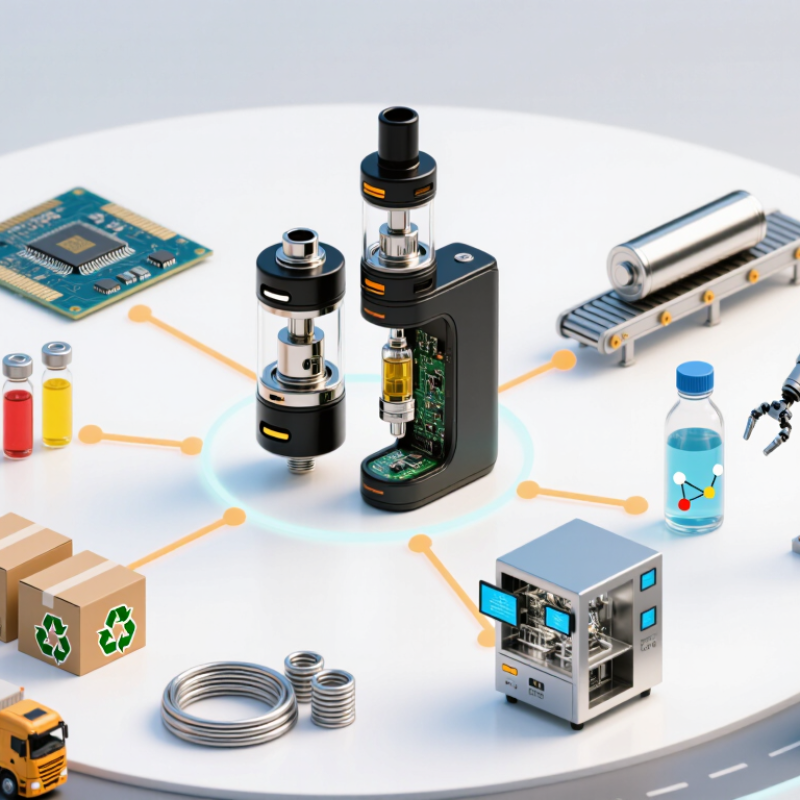
Grand View Research reported vape sales of $28.17 billion in 2023. That figure points to a broad manufacturing economy, not simply factories assembling devices. Electronics suppliers make circuit components, while battery specialists, plastics processors, and packaging companies provide other inputs. Liquid formulation and filling also require controlled production environments. The market estimate offers scale, but it does not tell us how revenue is divided among these industries. That matters.
The supply chain continues after production. Testing laboratories can assess consistency and device performance, while logistics firms move components and finished products. Retail and distribution activity also contribute to the wider commercial picture. Each stage depends on reliable specifications: a poorly fitted seal or inconsistent component can affect product quality. Small details count. Still, a large sales figure is not proof of uniform standards or equal growth across suppliers. Market reports use defined methods, and those boundaries can leave some activity out. It is tempting to treat $28.17 billion as a complete map of the industry. It is not. The number is a useful starting point, but careful comparisons need the report’s scope and measurement period.
| Industry / value-chain area | Role in vape manufacturing | Data point or factual indicator | Scope / source |
|---|---|---|---|
| Vape products market | Demand for e-cigarettes and vaping products supports the wider manufacturing and supply chain. | The global e-cigarette and vape market was estimated at US$28.17 billion in 2023. | Global; Grand View Research |
| Device and hardware manufacturing | Production and assembly of device housings, reservoirs, heating elements, and control components. | An e-cigarette uses an electronic heating element to produce an aerosol from a liquid or other material. | U.S. product definition; FDA |
| Battery and electronics supply | Supplies power cells and electronic components used in powered vape devices. | Battery-powered designs require electrical power for aerosol generation; specifications vary by device, so no single battery capacity represents the category. | Product-function indicator; FDA |
| E-liquid and ingredient production | Formulation and supply of liquids and ingredients used in refillable or prefilled products. | E-liquids may contain nicotine, flavorings, propylene glycol, and vegetable glycerin; formulations differ across products. | Product ingredient overview; FDA |
| Filling and packaging | Fills cartridges, pods, or bottles and prepares products for distribution. | In the EU, nicotine-containing e-liquids are subject to limits of 20 mg/ml nicotine concentration and 10 ml for refill-container capacity under the Tobacco Products Directive. | European Union; Directive 2014/40/EU, Article 20 |
| Testing and regulatory compliance | Supports product documentation, ingredient reporting, quality checks, and market-access requirements. | In the United States, a new tobacco product generally must receive FDA marketing authorization before it can be legally marketed. | United States; FDA |
| Distribution and retail | Moves finished products through wholesale and retail channels to adult consumers, subject to local rules. | Retail sales are part of the route to market; age restrictions and sales rules vary by jurisdiction. | Market-channel indicator; regulations vary by location |
| Waste and recycling services | Handles end-of-life devices, batteries, and packaging through applicable collection and waste systems. | Devices containing electrical components and batteries require disposal routes appropriate to their materials and local waste rules. | Waste-management indicator; requirements vary by jurisdiction |
Note: The US$28.17 billion figure is a global market estimate, not a breakdown of revenue by supply-chain industry. Regulatory limits shown apply only to the jurisdictions stated.
They act as carrier liquids and affect throat feel, vapor density, and flow. Their thickness can change with temperature.
A cool drum may pour more slowly than a warm one. That can affect mixing and equipment settings.
Suppliers provide identity, concentration, and batch records. Teams connect each drum to its production batch.
No. Food use alone does not establish inhalation suitability. Production teams review specifications and test finished liquid.
Teams screen materials, use calibrated scales, and store supplies carefully. A slight odor change may deserve investigation.
No. Records help trace batches, but they cannot catch every handling error. That still leaves gaps.
A U.S. regulator had authorized 34 specific e-cigarette products by 2024. It does not cover every device or item sold.
Teams may track components, battery checks, material records, seals, and packaging. A tiny leak matters.
Product details and requirements can change. Compliance is ongoing, not a one-time task. It is easy to miss something.
What industries are involved in vape manufacturing? The answer spans several connected sectors, beginning with agriculture and commodity processing, which supply plant-derived nicotine and other raw materials. Chemical producers provide propylene glycol, vegetable glycerin, and flavor ingredients, while testing laboratories assess material quality and consistency. Market estimates put vape sales at $28.17 billion in 2023, illustrating the scale of the supply chain, though market size varies by source and definition.
Electronics, battery, metals, plastics, and packaging industries contribute components and materials for device production. The International Energy Agency reported that electric-vehicle battery demand exceeded 1 terawatt-hour in 2024, reflecting broader growth in battery manufacturing capabilities that also serve many other applications. Assembly companies combine components, and quality-control specialists check product performance and safety. Regulatory and compliance teams support documentation, testing, labeling, and market authorization; by 2024, the U.S. Food and Drug Administration had authorized 34 e-cigarette products. Together, these sectors form a complex manufacturing network shaped by supply, engineering, and oversight.

 ERA Vape